What AI can now do·Jun 30, 2025·Medicine
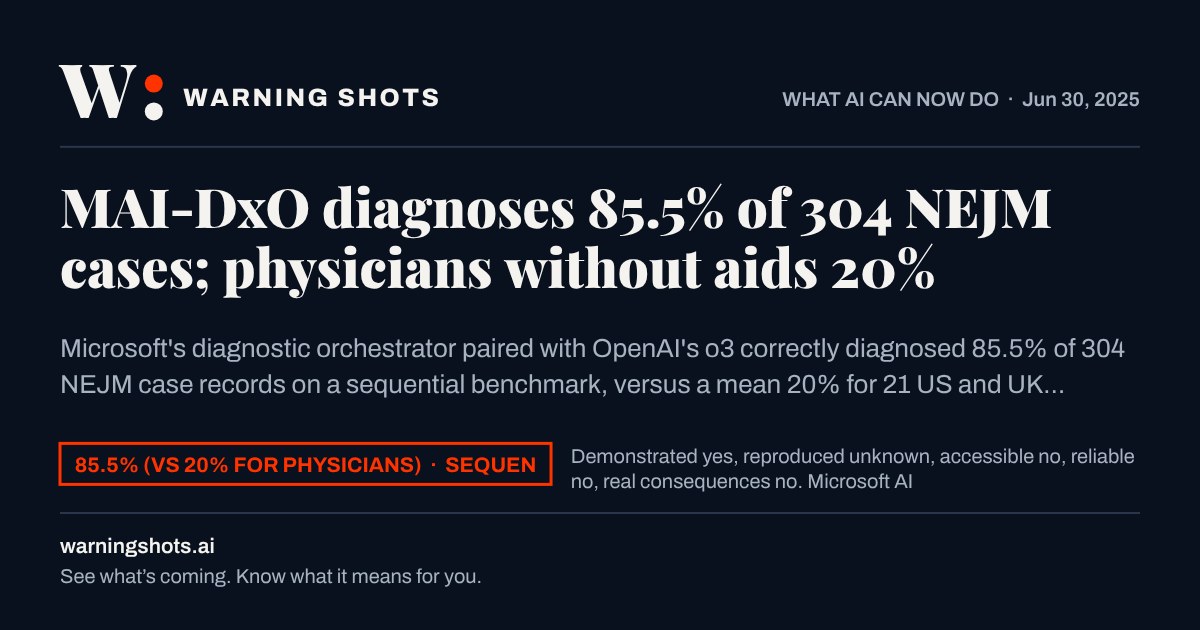
MAI-DxO diagnoses 85.5% of 304 NEJM cases; physicians without aids 20%
85.5% (vs 20% for physicians)Sequential Diagnosis Benchmark accuracy
Microsoft's diagnostic orchestrator paired with OpenAI's o3 correctly diagnosed 85.5% of 304 NEJM case records on a sequential benchmark, versus a mean 20% for 21 US and UK physicians working without references or colleagues, at lower testing cost.
How far it has travelled
Demonstratedshown once, by its developer or a researcher
yes · Jun 30, 2025 · 85.5% with o3 on 304 recent NEJM cases; MAI-DxO improved every model tested (GPT, Llama, Claude, Gemini, Grok, DeepSeek); physicians with 5-20 years' experience averaged 20% without tools. source
Reproducedshown again by someone else
unknown · Jun 30, 2025 · Benchmark and orchestrator are not public; Microsoft said the paper was being submitted for peer review; no independent replication was found for this entry. source
Accessibleavailable to the public or to customers
no · Jun 30, 2025 · Research demonstration only; SD Bench and MAI-DxO are not publicly available. source
Reliableworks most of the time on a defined task
no · Jun 30, 2025 · Not approved or validated for clinical use; tested on complex cases, not everyday presentations; Microsoft says safety testing, clinical validation and regulatory review are needed first. source
Real consequenceshas changed something in the world, for good or ill
no · Jun 30, 2025 · No deployment documented; Microsoft cites 50M+ daily health-related sessions on its consumer products as context, not as an outcome of MAI-DxO. source
What this could change for you
Nothing documented yet
Sources
A milestone is a dated, sourced result that moved what AI can do; a stage is upgraded only when a source shows it (a reproduction, a public release, production evidence, a documented consequence). “Unknown” is the honest default.